

Functional medicine gets dismissed as quackery by skeptics, yet thousands of patients report dramatic health improvements through this approach. At NuMed DPC, we’ve seen firsthand how addressing root causes rather than masking symptoms transforms lives.
The real question isn’t whether functional medicine works-it’s why conventional medicine has ignored prevention for so long. This post separates fact from fiction.
How Functional Medicine Differs From Conventional Care
Functional medicine operates on a fundamentally different premise than conventional medicine. Instead of waiting for disease to develop and then treating the symptoms, functional medicine focuses on identifying why your body is malfunctioning before illness takes hold. A patient with elevated blood sugar doesn’t simply receive a diabetes diagnosis and a prescription; the functional medicine approach investigates whether poor sleep, chronic stress, inflammatory foods, or sedentary habits are driving the problem. This distinction matters because treating the root cause prevents the disease from progressing, whereas managing symptoms alone leaves the underlying problem intact. Research published in Diabetologia demonstrated this approach works-a multimodal lifestyle intervention improved multiple health markers and reduced diabetes medication use in participants. Conventional medicine excels at acute emergencies and established disease protocols, but it struggles with the chronic conditions affecting most people today because it addresses what’s broken rather than why it broke.
Comprehensive Testing Reveals System Dysfunction
Functional medicine employs comprehensive lab work to spot imbalances before they become diagnosable diseases. Where conventional medicine orders basic cholesterol and glucose tests, functional medicine examines inflammatory markers, nutrient deficiencies, hormone patterns, and gut health indicators. A study in BMJ Open comparing functional medicine to standard care showed that this expanded testing framework identified patterns missed by traditional screening, leading to more targeted interventions. This isn’t excessive testing for profit; it’s strategic testing that maps how your body’s systems interact. Your thyroid function affects your metabolism, mood, and energy. Your gut bacteria influence your immune response and nutrient absorption. Your cortisol patterns shape your sleep, weight, and mental clarity. Conventional labs treat these as separate domains. Functional medicine treats them as interconnected systems, which means one intervention-like addressing sleep quality, can simultaneously improve blood sugar, inflammation, and mental health. The data support this approach: a clinical trial in PLOS ONE showed that inflammatory arthritis patients receiving functional medicine with personalized lifestyle changes experienced greater pain relief than those receiving standard care alone.
Sustainable Behavior Change Over Medication Dependency
Functional medicine prioritizes sustainable lifestyle shifts because medications mask problems without solving them. If you take a sleep medication nightly for five years, you haven’t fixed your sleep-you’ve developed a dependency while the underlying cause persists. The functional medicine approach identifies what actually disrupts your sleep: caffeine timing, screen exposure before bed, an irregular schedule, unmanaged anxiety, or a nutrient deficiency. Addressing the real cause takes more time upfront but creates permanent improvement. A multimodal intervention study in Alzheimer’s Research & Therapy found that cognitive decline improved through targeted nutrition, sleep optimization, stress reduction, and exercise, without pharmaceutical intervention. This doesn’t mean functional medicine rejects medication when necessary; it means practitioners use medication strategically while fixing what medication cannot. Extensive lab services and health coaching form the backbone of this work, allowing practitioners to monitor progress and adjust recommendations based on your body’s actual response rather than population averages.
Why Prevention Demands a Different Framework
The shift from symptom management to root cause analysis requires a different clinical framework entirely. Conventional medicine’s strength lies in its standardized protocols-they work reliably for acute illness and established disease. Functional medicine’s strength lies in its ability to detect dysfunction before it crystallizes into a diagnosis. This means the functional medicine practitioner spends time understanding your sleep patterns, stress levels, dietary habits, and family history in ways conventional appointments rarely allow. That investment of time upfront prevents years of medication and worsening health downstream. The evidence from multiple studies (including work in Crohn’s & Colitis 360 and PLOS ONE) consistently shows that addressing antecedents, triggers, and mediators of dysfunction produces better outcomes than treating disease after it develops. Prevention isn’t simply about avoiding illness; it’s about building resilience so your body can handle stress, process food efficiently, and maintain stable energy and mood. This framework explains why functional medicine appeals to patients frustrated with conventional care’s reactive stance.
What the Research Actually Shows
Peer-Reviewed Evidence Across Multiple Conditions
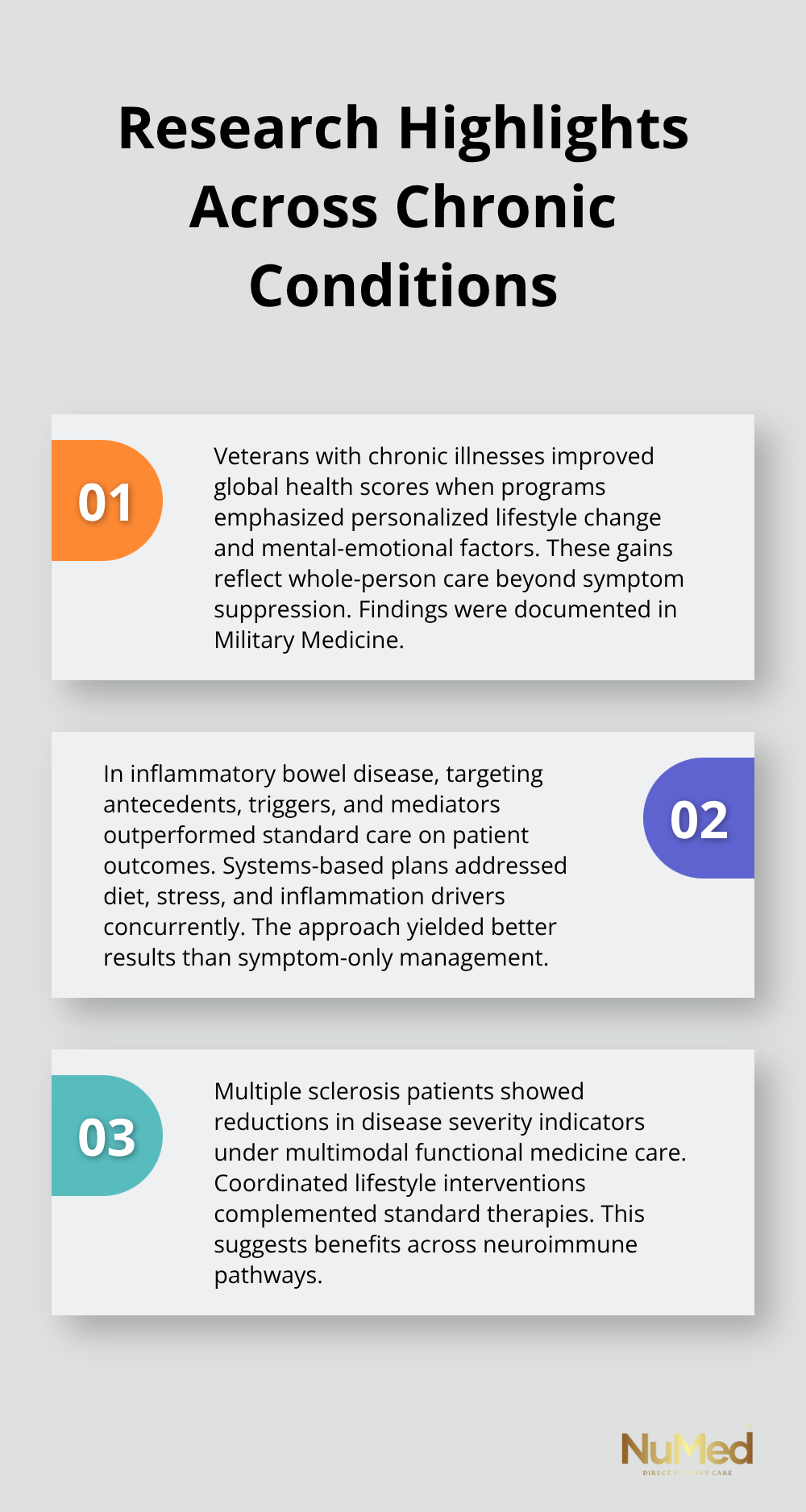
Real peer-reviewed research demonstrates measurable health improvements across multiple chronic conditions. A randomized controlled trial published in Diabetologia found that multimodal lifestyle interventions-the core of functional medicine-improved blood sugar control and reduced diabetes medication use. Veterans with chronic illnesses linked to occupational exposures experienced significant global health improvements through personalized lifestyle changes and attention to mental and emotional factors, as documented in Military Medicine. In inflammatory bowel disease, a functional medicine approach targeting antecedents, triggers, and mediators of dysfunction produced better outcomes than standard care alone, according to research in Crohn’s & Colitis 360. Multiple sclerosis patients showed reduced disease severity indicators when treated with multimodal functional medicine interventions compared to standard care.
Inflammatory arthritis patients receiving functional medicine with personalized lifestyle programs experienced greater pain relief than those on standard care, per a study in PLOS ONE.
Consistent Patterns Across Disease Categories
These results represent a consistent pattern across different disease categories rather than isolated successes. A self-funded health insurance plan documented lower pharmacy claim costs for musculoskeletal disorder patients receiving functional medicine care versus conventional treatment. The Institute for Functional Medicine maintains a research library that curates over a dozen published studies showing cost savings, improved biomarkers, and better patient-reported outcomes. Cognitive decline improved through targeted nutrition, sleep optimization, stress reduction, and exercise without pharmaceutical intervention, according to research in Alzheimer’s Research & Therapy. What makes this evidence compelling is its consistency: across diabetes, autoimmune disease, inflammatory conditions, and cognitive health, the same core interventions-sleep quality, stress management, dietary changes, movement-appear in nearly every successful study.
How Functional Medicine Addresses Root Causes
Functional medicine works for chronic conditions because it addresses the root causes of chronic conditions. When a patient with brain fog, joint pain, and digestive issues walks into a conventional doctor’s office, those get treated as three separate problems requiring three separate medications. Functional medicine investigates whether poor sleep quality, inflammatory foods, or chronic stress are driving all three. A community-based nutrition and lifestyle intervention delivered through shared medical appointments demonstrated health improvements in resource-limited populations, per BMC Public Health. The breadth of research spans conditions from type 2 diabetes to inflammatory arthritis to cognitive impairment, proving the functional medicine framework works across different body systems.
The Evidence Points to a Different Path
The research doesn’t suggest choosing between functional and conventional medicine; it shows that functional medicine excels where conventional medicine falls short. If you’re dealing with multiple chronic symptoms that haven’t resolved through standard care, the evidence indicates functional medicine’s systems-based approach offers a better path forward. Yet skeptics raise legitimate questions about how functional medicine practitioners distinguish themselves from those who exploit patient frustration with marketing hype rather than solid science.
Where Functional Medicine Skepticism Comes From
Functional medicine skepticism rests on legitimate concerns. Critics point to real problems: many practitioners operate outside insurance networks, charge thousands upfront for initial consultations, and recommend supplement protocols that exceed established evidence. McGill University’s Office for Science and Society has documented how functional medicine marketing often emphasizes root causes and systemic imbalance in ways that mirror wellness marketing more than rigorous clinical science. Patient safety depends on distinguishing legitimate practitioners from those who exploit frustration with conventional medicine.
The Insurance and Affordability Problem
Insurance companies exclude functional medicine partly because the field lacks standardized protocols that conventional medicine requires. A functional medicine practitioner in one state may recommend entirely different interventions than another for identical symptoms, making insurance coverage calculations impossible. This regulatory gap creates affordability barriers for patients who need this care most.
The upfront costs genuinely hurt. Initial consultations often run $500 to $1,500, comprehensive lab panels cost $1,000 to $3,000, and ongoing health coaching adds $200 to $400 monthly. For someone earning $40,000 annually, these expenses represent real barriers regardless of clinical effectiveness. Transparency about pricing matters, and practitioners should disclose all costs upfront without pressure tactics.
The Supplement Industry Problem
The supplement industry amplifies legitimate skepticism. High-profile functional medicine advocates market 400 to 500 products each, creating obvious financial incentives that cloud clinical judgment. The supplement industry lacks FDA approval for individual products in the way pharmaceuticals require, meaning quality varies dramatically, and contamination risks exist per the NIH’s Office of Dietary Supplements.
When practitioners recommend 10 to 15 supplements simultaneously without clear evidence for each, patients reasonably question whether they receive medicine or marketing. The real differentiation comes down to specificity and evidence. Reputable functional medicine practitioners order targeted tests based on clinical reasoning, not blanket panels that search for any abnormality. They recommend specific interventions backed by published research, not supplement stacks. They track objective outcomes and adjust recommendations when results don’t appear.
How to Identify Legitimate Practitioners
The Choosing Wisely campaign warns against unnecessary testing that generates false positives and anxiety while driving unproven treatments. Functional medicine practitioners who follow Choosing Wisely principles operate differently from those running testing mills.
Evaluating a practitioner requires asking direct questions: What specific tests do you order and why? What research supports each supplement you recommend? How do you measure whether treatment works? If answers remain vague or rely on detox language without specificity, that signals a red flag. If answers reference published studies, explain the testing rationale, and commit to tracking measurable outcomes, the practitioner operates with integrity.
Transparency as the Standard
Practitioners should charge transparently, explain their clinical reasoning, and provide evidence for their recommendations. Those who avoid direct answers about costs, testing protocols, or supplement justification warrant skepticism. Those who welcome questions and cite peer-reviewed research demonstrate the accountability that patient safety requires. The distinction between legitimate functional medicine and exploitative marketing hinges on whether practitioners prioritize evidence and transparency over profit.
Final Thoughts
The healthcare system stands at a crossroads. Conventional medicine excels at treating acute crises and established diseases, but it struggles with the chronic conditions affecting most people today because it waits for disease to develop before intervening. Functional medicine flips this equation by identifying dysfunction before it becomes diagnosable illness, making prevention the primary strategy rather than an afterthought. This shift matters because preventing type 2 diabetes costs far less than managing it for decades, and addressing sleep problems before they trigger depression saves years of suffering.
Personalized care represents the practical advantage functional medicine brings to patients who reject one-size-fits-all protocols. Your body differs from your neighbor’s, yet conventional medicine often applies population-average treatments to individual patients. Functional medicine practitioners invest time to understand your specific sleep patterns, stress levels, dietary habits, and family history, then tailor interventions accordingly. This personalization explains why the same intervention-improved sleep quality, for example, simultaneously improves blood sugar, inflammation, and mental clarity in some patients while others require different adjustments. The research consistently shows this individualized approach produces better outcomes than standardized protocols, and it separates legitimate functional medicine from functional medicine quackery that exploits patient frustration without evidence.
Integration with conventional medicine creates the strongest healthcare model. Functional medicine does not replace emergency care or proven pharmaceuticals; it complements them by addressing what medications cannot fix. A patient with inflammatory arthritis benefits from both pain relief medication and the personalized lifestyle changes that reduce inflammation at its source. This integrated approach prevents the false choice between functional and conventional-only care, and it reflects how we at NuMed DPC practice medicine through direct primary care that combines prevention with accessible support.