
Most patients visit their doctor with a symptom and leave with a prescription. At NuMed DPC, we take a different path by using a functional medicine approach that looks beyond what’s bothering you today.
Your genetics, environment, diet, and lifestyle all shape your health. Understanding these connections is how we identify what’s actually driving your condition, not just treating what you feel.
Why Functional Medicine Requires Extended Time and Deeper Analysis
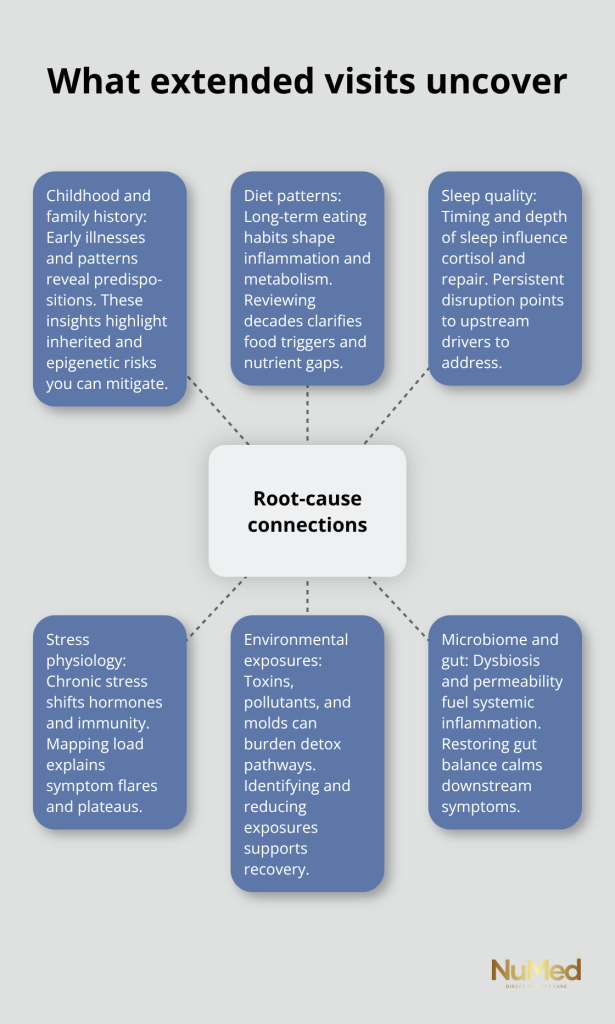
A 10-to-15-minute appointment cannot uncover what actually drives your condition. Extended consultation appointments allow practitioners to ask about your childhood illnesses, family history, diet patterns over decades, sleep quality, stress levels, and environmental exposures. This comprehensive approach reveals connections that quick visits miss entirely. A patient with fatigue might mention poor sleep in passing, but functional medicine practitioners investigate further to find that sleep disruption stems from unmanaged cortisol, which itself connects to gut inflammation from food sensitivities. Traditional medicine would prescribe stimulants; functional medicine addresses the root.
How Genetics and Environment Interact
Your DNA loads the gun, but your environment pulls the trigger. Functional medicine practitioners analyze your genetic predispositions alongside your actual lifestyle and exposures to determine which health risks are real for you specifically. Someone with a family history of diabetes needs different interventions than someone without that genetic risk, and both need different plans than someone whose blood sugar dysregulation comes primarily from chronic stress. Advanced laboratory testing, including personalized laboratory testing for microbiome analysis and hormonal assessment, provides the data to personalize treatment rather than apply population averages to your individual case. Research from the American Heart Association and American Cancer Society shows that lifestyle modifications tailored to individual risk factors reduce disease incidence far more effectively than generic prevention advice.
Why Identical Diagnoses Require Different Protocols
Two people with the same autoimmune diagnosis may have completely different root causes. One might have leaky gut from NSAID overuse; another might have dysbiosis from repeated antibiotic courses; a third might have molecular mimicry triggered by a specific food. Traditional medicine treats the diagnosis. Functional medicine treats the person. Your personalized plan might emphasize anti-inflammatory nutrition, targeted supplementation, stress reduction techniques, and sleep optimization, while your neighbor with the same diagnosis receives an entirely different protocol. This individualization requires continuous monitoring of your response and adjustment of your plan accordingly. You follow your biology, not a standard protocol.
Continuous Adjustment Based on Your Response
Functional medicine relationships are ongoing rather than episodic because your health changes and your treatment must adapt. Practitioners track how you respond to nutritional changes, supplementation, and lifestyle modifications over weeks and months. What works in month one may need adjustment in month three as your body heals and your needs shift. This continuous dialogue between you and your practitioner ensures that your plan evolves with your actual results, not with theoretical expectations. The next step in understanding functional medicine involves examining the specific laboratory tests and biomarkers that reveal your individual health picture.
Laboratory Testing and Personalized Nutrition: The Foundation of Your Health Plan
How Advanced Testing Reveals Your Individual Health Picture
Laboratory testing at NuMed DPC serves as a window into the specific dysfunctions driving your symptoms, not as a checkbox exercise. A standard annual physical might include basic blood work, but functional medicine testing penetrates far deeper. Microbiome analysis reveals whether dysbiosis fuels your digestive problems or triggers systemic inflammation that manifests as brain fog or joint pain. Hormonal panels assess not just whether your thyroid falls within the normal range, but whether it functions optimally for you specifically-a distinction that matters enormously when normal ranges span values that produce vastly different symptoms.
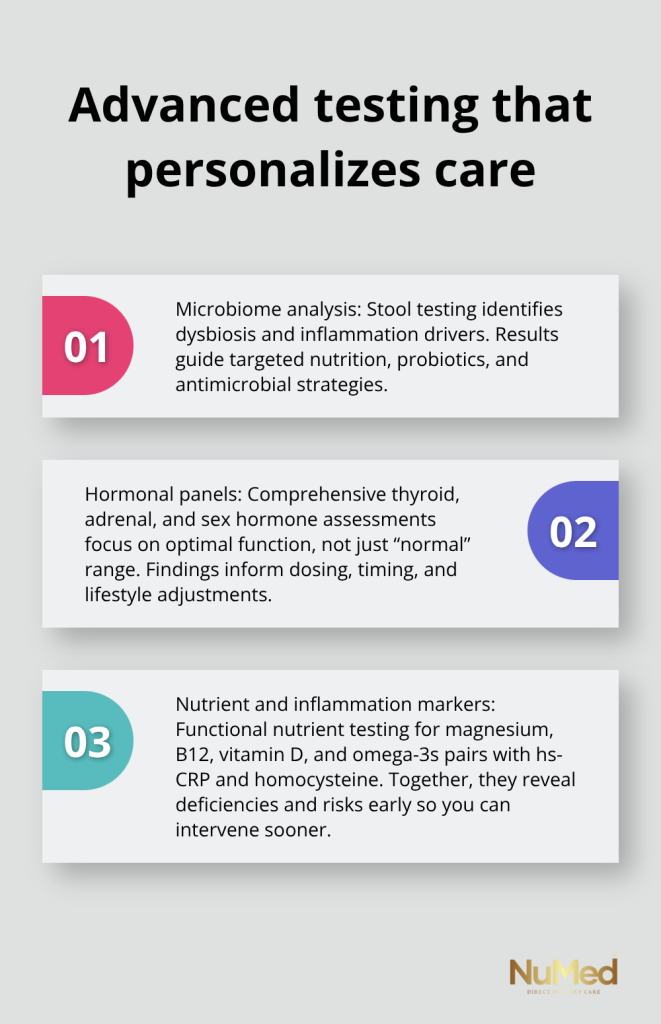
Advanced testing for nutrient status identifies deficiencies in magnesium, B12, vitamin D, and omega-3 fatty acids that conventional labs often miss because they measure serum levels rather than functional markers. Inflammatory markers like high-sensitivity C-reactive protein and homocysteine predict cardiovascular and neurological risk years before symptoms appear. Genetic testing for conditions like MTHFR mutations or ApoE status guides your supplement choices and dietary approach rather than creating unnecessary alarm.
The Principle Behind Meaningful Testing
Testing should answer specific questions about your health, not generate data for its own sake. We measure what matters to your individual situation, then use those results to build a precise treatment plan rather than applying population-based assumptions to your unique biology. This targeted approach eliminates unnecessary testing while ensuring that every result informs your personalized nutrition strategies.
Nutrition as Your Treatment Foundation
Your nutrition and lifestyle form the foundation of every treatment protocol we develop, and this foundation must align with your actual preferences, constraints, and biology. An anti-inflammatory diet helps most people with chronic disease, but the specific foods that work for you depend on your microbiome composition, your food sensitivities revealed through elimination protocols, and your cultural or religious food preferences. Someone with severe dysbiosis might thrive on bone broth and fermented foods; someone else with autoimmune disease might need strict avoidance of nightshades; a third person might flourish on Mediterranean patterns, while another needs lower-carbohydrate approaches based on their glucose response patterns.
Continuous glucose monitoring reveals how your individual body responds to specific foods, removing guesswork from dietary choices. Research consistently shows that individuals who address sleep quality and stress alongside nutrition see dramatically better outcomes than those who focus on diet alone.
Sleep, Stress, and Complementary Therapies
Stress management and sleep optimization are not optional add-ons but central to treatment because cortisol dysregulation and sleep deprivation perpetuate inflammation, dysbiosis, and hormonal imbalance. When conventional therapies prove insufficient or carry unacceptable side effects, we integrate evidence-backed complementary approaches like targeted supplementation, herbal medicine for specific conditions, or manual therapies that support your body’s healing capacity. This integration always occurs within a framework of safety and drug-interaction monitoring, never as a replacement for necessary medications.
Your Active Role in Treatment Adjustment
The practitioner-patient relationship becomes collaborative, with you actively adjusting your plan as you learn what your body responds to, rather than passively following directives from a provider. Your continuous feedback about how you feel, how your energy shifts, and how your symptoms change informs real-time adjustments to your nutrition, supplementation, and lifestyle protocols. This dynamic partnership means your treatment plan evolves with your actual results, not with theoretical expectations. Understanding how to implement these personalized interventions requires practical strategies that fit your life, which we explore in the next section.
How Functional Medicine Treats the Conditions That Conventional Care Manages Poorly
Functional medicine excels at conditions that conventional medicine struggles with because it addresses what’s actually driving the problem rather than suppressing symptoms. Type 2 diabetes illustrates this perfectly: conventional care typically prescribes metformin and insulin as blood sugar climbs, but functional medicine investigates whether the dysglycemia stems from insulin resistance rooted in visceral fat and chronic inflammation, from dysbiosis that impairs glucose regulation, from unmanaged cortisol and sleep deprivation, or from specific nutrient deficiencies like chromium or magnesium. Lifestyle interventions targeting root causes can improve glycemic control significantly, yet conventional primary care rarely implements intensive lifestyle protocols because time constraints make them unfeasible. Extended visits and comprehensive assessment make this reversal possible.

Autoimmune Conditions Respond to Root-Cause Identification
Autoimmune conditions like Hashimoto’s thyroiditis and rheumatoid arthritis respond dramatically when practitioners identify and eliminate the specific triggers driving immune activation in each patient. One person’s flare traces to gluten sensitivity that causes intestinal permeability; another’s stems from SIBO that allows bacterial lipopolysaccharides to cross the intestinal barrier; a third’s originates from viral reactivation caused by low vitamin D. Elimination diets combined with targeted supplementation and stress management protocols reduce autoimmune flares and improve quality of life scores significantly in patients who previously cycled through immunosuppressive medications.
Digestive Disorders Heal Through Microbiome Rebalancing
Digestive disorders, including IBS, SIBO, and inflammatory bowel disease, respond to microbiome rebalancing through specific dietary approaches, targeted antimicrobial or probiotic supplementation, and healing protocols that repair intestinal barrier function. Standard gastroenterology often prescribes proton pump inhibitors for reflux without addressing the dysbiosis or food sensitivities that actually cause the condition, leading to perpetual medication dependence that worsens microbiome health over the years.
Metabolic and Hormonal Optimization Prevents Chronic Disease
Metabolic and hormonal optimization prevents the chronic diseases that dominate healthcare spending and suffering. Women approaching perimenopause face a choice: accept hot flashes, mood instability, and weight gain as inevitable, or work with practitioners who assess estrogen metabolism, liver detoxification capacity, nutrient status, and stress physiology to create protocols that maintain metabolic health and vitality through this transition. Functional medicine testing reveals whether someone’s metabolic syndrome stems primarily from visceral fat and insulin resistance, from chronic inflammation, from cortisol dysregulation, or from a combination that requires different interventions.
A person with elevated blood pressure driven by sympathetic nervous system overactivation needs different treatment than someone whose hypertension reflects sodium sensitivity or arterial stiffness from advanced glycation end products. Continuous glucose monitoring data combined with food-response testing allows precise identification of which specific foods dysregulate each individual’s glucose, enabling dietary changes that produce measurable metabolic improvement within weeks rather than months.
Cancer Prevention Through Early Intervention
The American Cancer Society’s 2020 guidelines documented that sustained lifestyle modification, including weight loss, increased physical activity, and dietary changes, reduces cancer incidence and improves survival across multiple cancer types, yet most oncology practices never implement these interventions systematically. Functional medicine practitioners treat cancer prevention seriously by identifying metabolic dysfunction, chronic inflammation, hormonal imbalances, and environmental exposures years before cancer develops, then implementing targeted interventions that measurably improve biomarkers associated with cancer risk.
Final Thoughts
Functional medicine represents a fundamental shift from treating diseases to treating people. This approach works because it respects your biology rather than forcing your health into standardized categories-your genetics, microbiome, nutrient status, stress physiology, and environmental exposures create a unique health picture that requires equally unique interventions. Extended visits, comprehensive testing, and personalized nutrition protocols reveal what’s actually wrong, then target root causes rather than perpetually managing symptoms with medications that often create new problems.
The conditions that conventional medicine struggles with-autoimmune disease, metabolic dysfunction, digestive disorders, and hormonal imbalance-respond dramatically when practitioners identify and eliminate their specific triggers in each patient. This isn’t theoretical; it’s a measurable improvement in biomarkers, energy levels, symptom severity, and quality of life within weeks and months. Modern health challenges demand this functional medicine approach because chronic disease now accounts for most healthcare spending and suffering, yet most conventional practices lack the time, tools, and framework to address root causes.
If you’re managing chronic symptoms, cycling through medications without improvement, or seeking to prevent disease before it develops, a different path exists. We at NuMed DPC provide exactly this approach through extended visits, comprehensive lab services, functional medicine expertise, and health coaching tailored to your individual needs. Your health deserves more than a 15-minute appointment and a prescription.