
Menopause brings significant hormonal shifts that reshape how your body stores fat and burns calories. Weight gain during this transition affects roughly 80% of women, making it one of the most common concerns we address at NuMed DPC.
The good news is that menopause weight management isn’t about restrictive dieting or extreme exercise. With the right nutrition, movement, and lifestyle strategies, you can maintain a healthy weight while feeling your best during this life stage.
Why Your Body Stores Fat Differently During Menopause
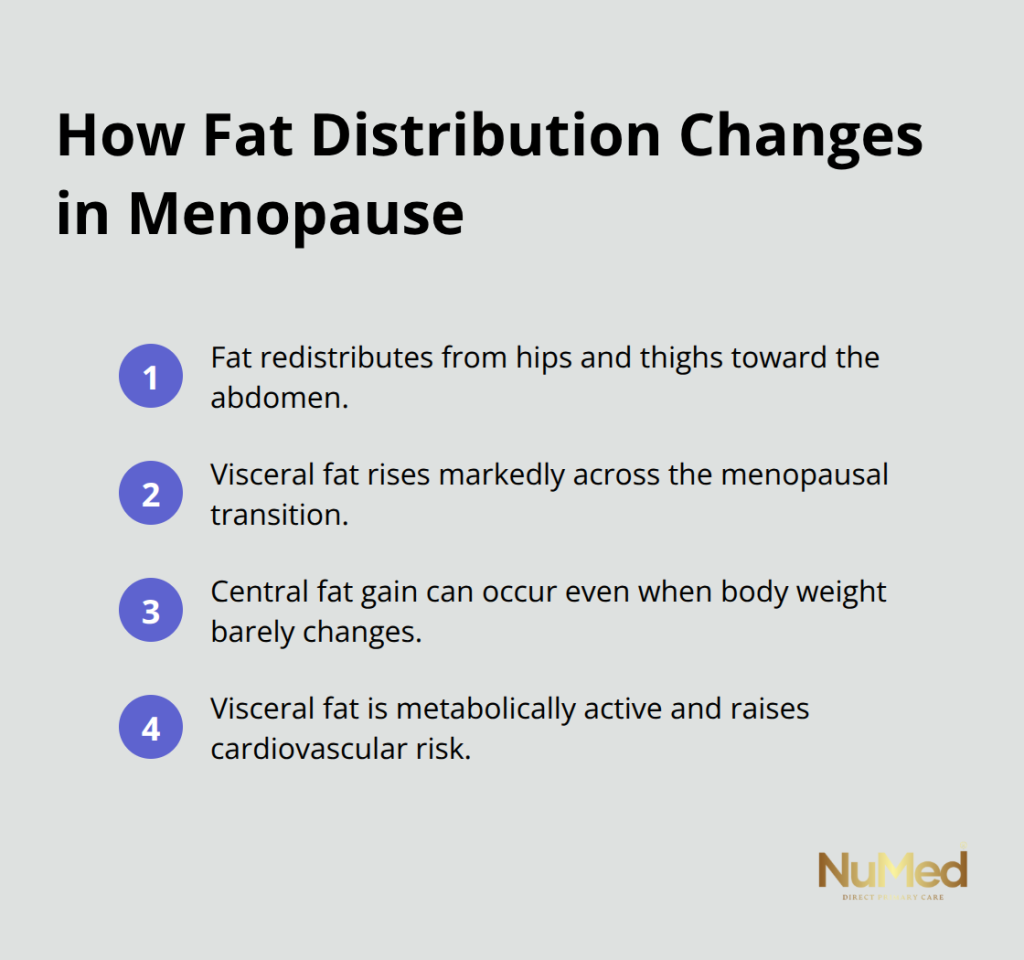
Declining estrogen does not cause weight gain on its own, but it fundamentally changes where your body deposits fat. During perimenopause and menopause, fat shifts away from your hips and thighs toward your abdomen and organs. This redistribution happens in the first year of menopause and creates what many women notice as central weight gain, even when the scale barely moves. Visceral fat-the fat around your organs-increases significantly during this transition, rising from roughly 5–8% of total fat in perimenopause to about 15–20% after menopause. This shift matters because visceral fat is metabolically active and raises cardiovascular risk far more than fat stored elsewhere.
Your Metabolism Declines With Age, Not Just Hormones
Your metabolism also declines with age, independent of hormones. Research from the MONET Group, published in the European Journal of Clinical Nutrition in 2013, found that perimenopausal women burn approximately 200 fewer calories daily when activity becomes more sedentary. Age-related losses in organ mass and muscle tissue lower your resting metabolic rate steadily over the menopausal transition. Most of the weight gain during menopause stems from reduced physical activity and aging rather than hormones alone, which means the levers you can pull are largely in your control.
Sleep Disruption Drives Excess Eating
Night sweats and sleep disruptions during menopause directly sabotage appetite regulation. Poor sleep alters your hunger and fullness cues, triggering cravings for energy-dense foods and reducing satisfaction after meals, which drives excess calorie intake. Improving sleep quality and managing nighttime symptoms becomes a practical priority because it directly supports appetite control and energy balance.
Muscle Loss Accelerates Fat Gain
Menopause coincides with accelerated loss of lean muscle mass, flexibility, and strength, making weight management harder even if you eat the same way. Without intervention, you lose muscle while gaining fat, which worsens your metabolic rate and body composition. This is why strength training matters during menopause; it directly counters muscle loss, supports your metabolism, and can reduce fat even without large weight changes. Starting strength training at a challenging weight and progressively increasing the load preserves or builds muscle when paired with adequate protein intake of 1.0 to 1.2 grams per kilogram of body weight daily. The combination of resistance work and sufficient protein creates the foundation for sustainable weight management as your body composition shifts.
Nutrition That Supports Your Body During Menopause
Protein becomes non-negotiable during menopause because your muscles need it to stay intact while hormones shift. Aim for 1.0 to 1.2 grams of protein per kilogram of body weight daily. High-quality sources like lean meats, fish, eggs, legumes, and soy deliver amino acids that preserve muscle mass and improve satiety, meaning you feel fuller longer after meals. This matters because adequate protein directly counters the muscle loss that accelerates during menopause and sabotages your metabolism. Without enough protein paired with strength training, your body loses muscle tissue even if weight stays stable on the scale, which is metabolically worse than weight gain alone.
Fiber Controls Blood Sugar and Appetite
Fiber acts as a practical tool to manage the blood sugar swings that drive cravings during menopause. Try 30 grams daily from whole, unprocessed foods like whole grains, legumes, fruits, and vegetables. Fiber improves insulin sensitivity through changes in your gut microbiota and extends fullness between meals, which limits excess calorie intake when appetite hormones are already disrupted. The combination of adequate protein and high fiber at each meal creates a metabolic buffer against the cravings and energy crashes that make weight management harder during this transition.
Hydration Supports Metabolic Function
Drinking water consistently throughout the day supports your metabolism and helps you distinguish true hunger from thirst. Many women mistake dehydration for hunger, leading to unnecessary eating. Water also helps manage night sweats (which disrupt sleep and appetite regulation) by maintaining adequate fluid balance and supporting kidney function as your body adjusts to hormonal changes. While hydration alone does not drive weight loss, it removes a common barrier to successful weight management and supports the metabolic processes that become less efficient with age.
Movement Patterns Amplify Nutrition Gains
The nutrition strategies above work best when paired with intentional movement. Small daily activities-what researchers call non-exercise activity thermogenesis (NEAT)-account for 15 to 30 percent of your total energy expenditure. This means consistent strength training and everyday movement patterns multiply the effects of your protein and fiber intake, creating sustainable weight management without extreme restriction. The next section explores how to structure exercise during menopause to maximize these nutrition gains and preserve the muscle and bone strength that matter most as you age.
Exercise and Lifestyle Approaches for Sustainable Results
Strength Training Protects Muscle and Metabolism
Strength training during menopause is not optional if you want to preserve muscle, maintain your metabolism, and protect your bone density as you age. The research is unambiguous: resistance exercise directly counters hormone-driven muscle loss during menopause and improves body composition even when the scale doesn’t move. Start with a weight or resistance level that feels genuinely challenging for 8 to 12 repetitions, then progressively increase the load every 2 to 3 weeks as your strength improves. This approach works with bodyweight exercises, resistance bands, free weights, or barbells-the method matters far less than consistency and progressive overload. Try regular physical activity 2 to 3 times per week, targeting major muscle groups like your legs, chest, back, and core.
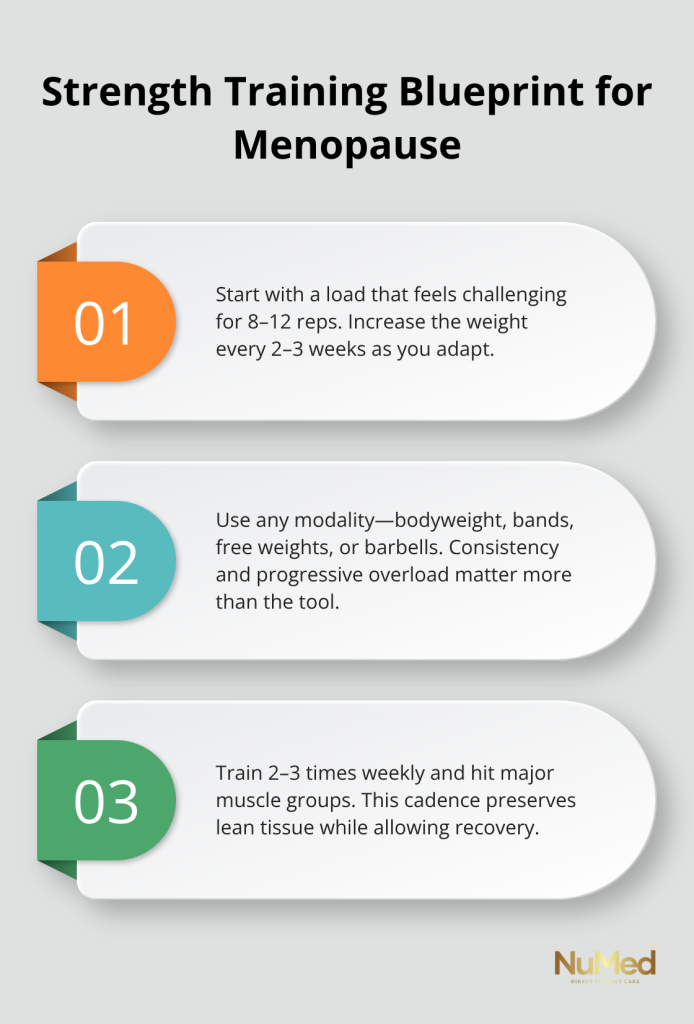
This frequency preserves lean tissue while leaving recovery time between sessions.
Cardiovascular Activity Complements Resistance Work
Cardiovascular activity complements strength work but should not replace it; moderate-intensity cardio like brisk walking, cycling, or swimming for 150 minutes per week supports heart health and metabolic function without the joint stress that high-impact exercise creates during menopause. The combination of strength and cardio creates metabolic resilience that nutrition alone cannot achieve. Short walks after meals, stretching, or gentle yoga on non-strength training days provide stress relief without adding fatigue and amplify the benefits of your resistance work.
Sleep Quality Determines Your Body’s Response
Sleep quality directly determines whether your body preserves muscle or stores fat during menopause, making it as important as exercise and nutrition. Night sweats disrupt sleep architecture and trigger cortisol release, which drives belly fat storage and undermines the progress you make in the gym and kitchen. Practical steps include keeping your bedroom cool (around 65 to 68 degrees Fahrenheit), wearing moisture-wicking sleepwear, and limiting caffeine after 2 PM to reduce nighttime temperature fluctuations. Try to get adequate sleep nightly because quality rest supports metabolic function and reduces stress hormones, making weight management exponentially easier.
Stress Management Amplifies Sleep and Exercise Benefits
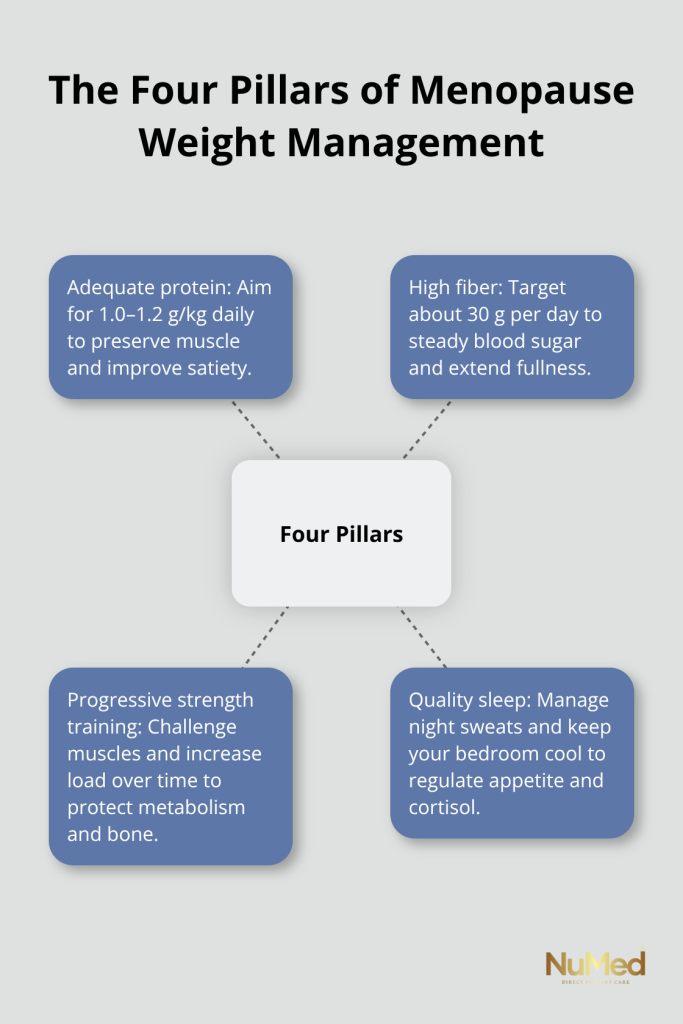
Chronic stress elevates cortisol and promotes visceral fat accumulation around your organs, the exact pattern that menopause already triggers. Stress management amplifies sleep benefits and works synergistically with your exercise routine. Strength training itself regulates cortisol when you do it consistently, and regular movement throughout your day further reduces stress without adding fatigue. Direct communication with a healthcare provider about symptoms that disrupt your sleep helps you address root causes rather than managing effects alone. The four pillars-adequate protein, high fiber, progressive strength training, and quality sleep-work together; neglecting any one undermines the others and makes sustainable weight management feel impossible when it is actually achievable with the right integrated approach.
Final Thoughts
Menopause weight management succeeds when you treat it as a long-term shift in how you care for your body, not a temporary problem to solve. The four pillars-adequate protein, high fiber, progressive strength training, and quality sleep-work together because they address the real drivers of weight change: declining metabolism, muscle loss, sleep disruption, and fat redistribution. Consistency matters far more than perfection, and small, sustainable changes compound over months and years while extreme approaches fail because you cannot maintain them when hormones shift, and life gets busy.
Your body responds differently to menopause than it did to weight management in your thirties or forties. This is not failure; it is biology. What worked before may not work now, which is why a personalized approach tailored to your specific symptoms, activity level, and health history makes the difference between frustration and real progress. One woman’s solution, say, adding strength training three times weekly, may not be another woman’s path forward if sleep disruption or stress hormones are her primary barrier.
Working with a healthcare provider who listens and adjusts your plan over time becomes invaluable for sustainable menopause weight management. Start with one or two changes this week (perhaps adding a protein source at breakfast or scheduling two strength training sessions), then build from there. If menopause symptoms disrupt your progress, contact a provider who can help you address root causes rather than manage effects alone.