

Most people know they should move more, eat better, and sleep well. But knowing what to do and actually doing it are two different things.
At NuMed DPC, we’ve seen firsthand how a lifestyle management plan transforms health outcomes when it’s tailored to your real life. This guide walks you through building a daily routine that actually works for you, not against you.
Where to Start: Taking Stock of Your Current Life
Map Your Actual Daily Patterns
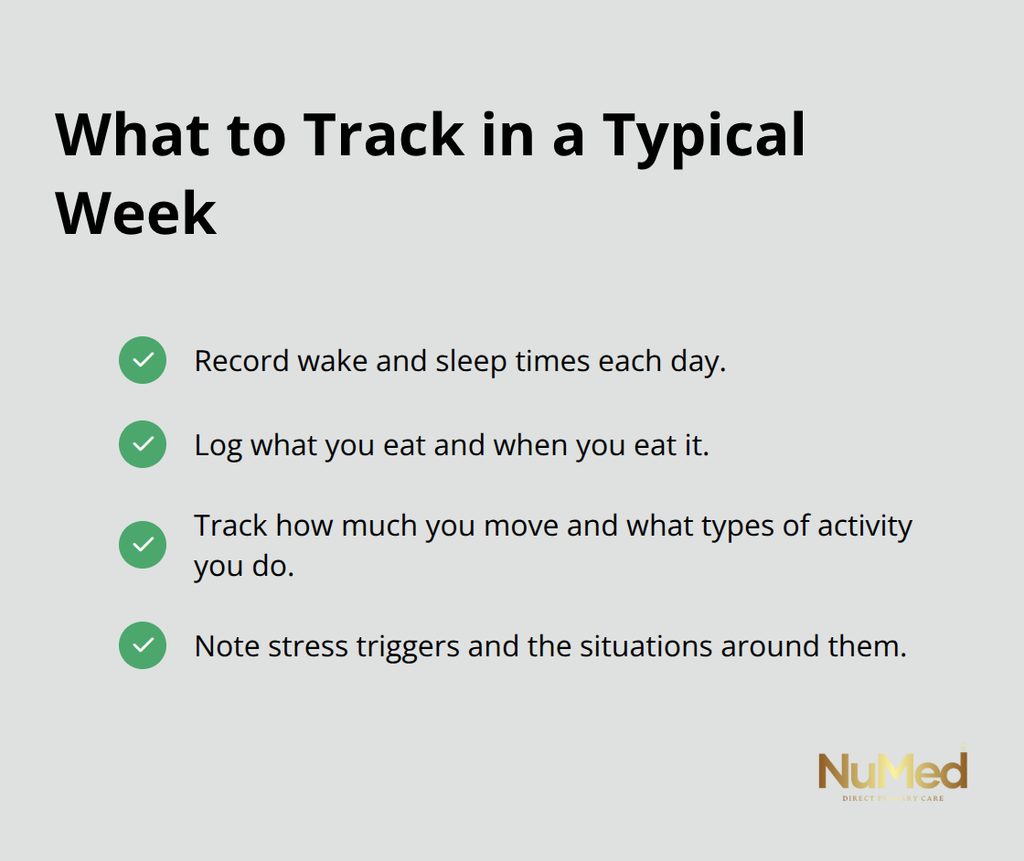
The first step toward building a lifestyle management plan is honest assessment. Most people skip this and jump straight into New Year’s resolutions or dramatic overhauls, which is why most fail within weeks. You need to map your actual daily patterns before making any changes. Start by tracking a typical week without judgment. Write down when you wake and sleep, what and when you eat, how much you move, and stress triggers. The CDC reports that 6 in 10 adults have at least one chronic condition and about 4 in 10 have two or more, yet many don’t understand how their daily habits directly fuel these conditions.
Measure Your Baseline Objectively
Use simple tools like the ACLM Diet Screener, Physical Activity Vital Sign, and Pittsburgh Sleep Quality Index to measure baseline performance objectively. These aren’t intimidating questionnaires-they’re straightforward assessments that take minutes and give you concrete data instead of guesses. Document your numbers: current weight, resting heart rate, blood pressure, sleep duration, and how many servings of vegetables you actually eat daily, not how many you think you should. This baseline matters because you cannot improve what you don’t measure.
Identify Your Personal Health Priorities
Next, identify which health priorities matter most to you personally. Heart disease and cancer caused nearly 40 percent of all U.S. deaths in 2022, and more than 80 percent of heart disease and stroke are preventable through lifestyle changes, according to the CDC. That statistic sounds abstract until it connects to your own risk factors or family history. Do you have elevated cholesterol, prediabetes, high blood pressure, or a family history of early heart disease? Are you struggling with energy, joint pain, or mood issues that interfere with work or relationships? These are your real priorities, not generic wellness goals.
Set Specific, Actionable Health Targets
Write your priorities down specifically: not just lose weight, but reduce joint pain so you can play with your kids, or lower blood sugar to avoid medication. Set one to three primary health targets maximum. People who chase five goals simultaneously abandon all of them. When you have clarity on what matters, you can design a daily routine that serves your actual life, not an imaginary version of yourself-and that foundation positions you to build sustainable habits that stick.
How to Structure Your Day for Real Results
Anchor Your Routine to Specific Times and Places
The gap between intention and action closes when you stop thinking about lifestyle changes in abstract terms and start anchoring them to specific times and places in your actual schedule. A structured daily routine removes the friction that derails most people. Instead of deciding each morning whether you exercise, you schedule it at 6:30 a.m. on Tuesday and Thursday. Instead of wondering what to eat for lunch, you prep meals on Sunday. The American College of Lifestyle Medicine recommends starting with brief, patient-centered behavior-change conversations and setting small, achievable goals like adding one extra vegetable serving daily. This approach works because it treats lifestyle management as a system, not willpower. Your schedule becomes the guardrail that keeps you on track.
Build Your Three Non-Negotiable Pillars
Start by blocking time for the three non-negotiable pillars: movement, nutrition, and sleep. Movement should occupy at least 150 minutes per week of moderate-intensity activity, such as brisk walking-roughly 30 minutes five days per week, which fits into almost any schedule if you commit to specific days and times. Pair this with two days of strength training.
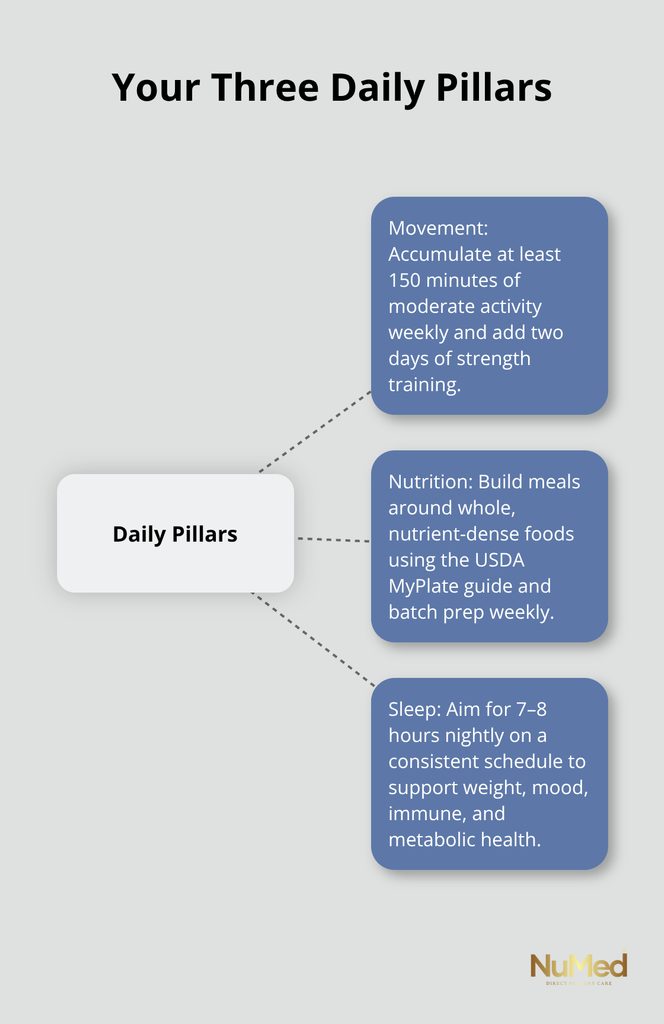
Nutrition requires a different kind of structure. Rather than rigid meal plans, you build meals around whole, nutrient-dense foods using the USDA MyPlate visual guide to plan balanced plates. The practical step is meal planning and prep on one day each week, ideally Sunday. You spend two to three hours preparing proteins, chopping vegetables, cooking grains, and portioning snacks. This single action removes the daily decision-making that leads to poor food choices.
Sleep is non-negotiable: aim for 7 to 8 hours per night with a consistent schedule, even on weekends. Research shows that adequate sleep supports weight control, mood, immune function, and metabolic health.
Track Progress Without Obsession
You should use specific tools to track your adherence without becoming obsessive. A simple spreadsheet or app like MyFitnessPal for nutrition, Strava for movement, or Sleep Cycle for sleep patterns gives you weekly data that reveals patterns you cannot see in the moment. The key is reviewing this data weekly, not daily, to spot trends and adjust before small slips become major derailments. If you miss three workouts in a row, that’s a signal to reassess your schedule or your motivation, not a reason to quit.
Align Your Routine With Your Real Life
The most sustainable daily routines are those that align with your existing life, not ones that demand you become a different person. If you hate running, don’t schedule running. If you work nights, don’t force a 6 a.m. gym session. The structure should fit your constraints, not fight them. When obstacles arise-a schedule change, unexpected stress, or a motivation dip-you need a healthcare partner who understands your full health picture and can adjust your plan as circumstances shift. Direct access to your provider through phone, text, or email means you can ask questions about your routine in real time rather than waiting weeks for an appointment. Same-day or next-day appointments let you address obstacles immediately instead of letting them compound.
The reality is that life changes constantly, and your routine must adapt with it. What works in January may not work in June when your work schedule shifts or family demands increase. This is where the next chapter becomes essential: learning how to handle the obstacles and setbacks that inevitably test your commitment to lifestyle change.
When Your Routine Breaks
Most people abandon their lifestyle plans not because the plan is wrong, but because life interrupts it. A work crisis demands extra hours. Your child gets sick and sleep vanishes. You travel for three weeks and your gym routine evaporates. The research is clear: people who expect obstacles and plan for them succeed far more often than those who pretend their routine will remain static. What fails is the all-or-nothing thinking that treats one missed workout or one poor meal choice as total failure. What works is treating your routine as a living system that needs regular maintenance and recalibration.
Time Pressure Is Real, Not an Excuse
Time constraints are the most common reason people abandon lifestyle plans, and they are legitimate. Research from the Journal of the American Medical Association shows that clinicians cite insufficient time in visits as the primary barrier to lifestyle counseling. If your doctor struggles to fit lifestyle guidance into 15-minute appointments, you certainly struggle to fit a new routine into an already packed schedule. The solution is not finding more time, which does not exist. The solution is protecting your non-negotiable time blocks ruthlessly and eliminating lower-priority activities. If you have committed to 30 minutes of movement on Tuesday and Thursday at 6:30 a.m., that appointment with yourself ranks above checking email or scrolling social media.
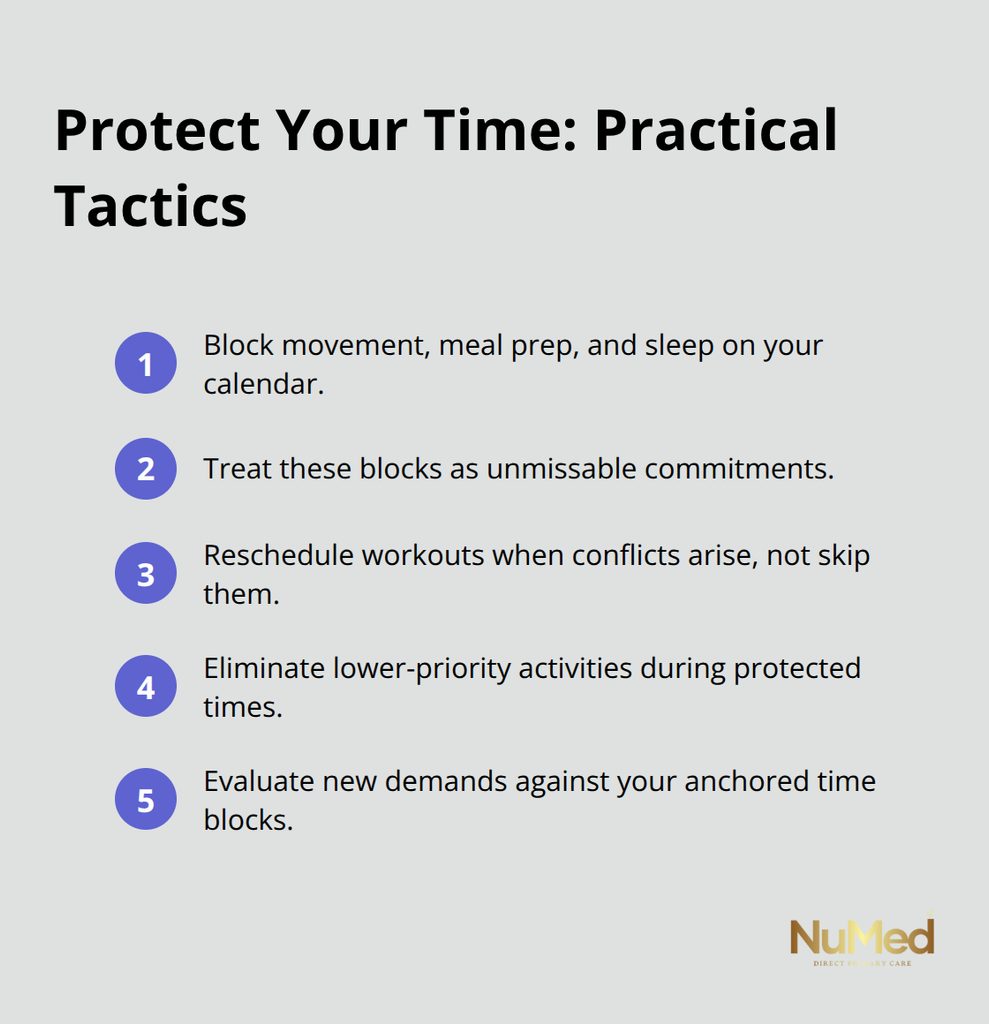
One practical tactic is scheduling your movement, meal prep, and sleep times in your calendar exactly as you would schedule work meetings. Treat them as unmissable commitments. When competing demands arise, you evaluate them against these anchored times rather than abandoning your routine entirely. If a work meeting conflicts with your Thursday workout, you reschedule the workout to Wednesday or Friday, not skip it. The structure persists even when individual days shift.
Motivation Fluctuates, Systems Remain
Motivation is not a reliable engine for sustained behavior change. Initial enthusiasm typically lasts before the novelty wears off and the routine becomes work. This is normal and predictable, not a personal failure. The people who succeed are those whose routines survive the motivation dip because they have built systems, not willpower-dependent practices. Your system includes your calendar, your meal prep containers, your tracking spreadsheet, and your accountability structure. When motivation dips in week seven, your system keeps you moving because the friction to act is low. You have already prepped meals, your workout sits blocked on the calendar, and your tracking app reminds you of your progress. Many people also underestimate the role of small wins in rebuilding motivation. If you have tracked your sleep for six weeks and see that consistent 7-hour nights correlate with better energy and fewer afternoon cravings, that concrete data rekindles motivation more powerfully than abstract health goals. When motivation dips, review your baseline metrics and your progress over the past four to eight weeks. The data often shows improvements you did not consciously notice.
Life Changes Demand Routine Evolution
A promotion, a move, a new relationship, a health diagnosis, or aging itself changes your constraints and capabilities. Your routine cannot remain frozen. The key is having a healthcare provider who understands your full picture and can help you adjust your plan when circumstances shift. Direct access to your provider through phone, text, or email means you do not wait weeks for an appointment to troubleshoot a routine that has stopped working. Same-day or next-day appointments let you address obstacles immediately. When your work schedule changes or a chronic condition emerges, you can quickly reassess your movement targets, nutrition strategy, or sleep schedule with professional guidance. A provider who knows your history, understands your actual daily constraints, and can help you build a revised routine serves your current reality, not your previous one. This kind of ongoing adjustment requires a healthcare model that prioritizes your individual needs and supports you through the inevitable shifts that life brings.
Final Thoughts
Your lifestyle management plan succeeds when you treat it as an ongoing partnership rather than a solo project. Consistent lifestyle changes compound over time-more than 80 percent of heart disease and stroke become preventable through sustained behavioral shifts, and adults who maintain regular physical activity reduce all-cause mortality by roughly 35 to 42 percent over the long term. These gains represent the difference between managing chronic disease and preventing it altogether.
A healthcare provider who understands your full picture, knows your actual daily constraints, and adjusts your routine as life changes makes the difference between a plan that fails and one that endures. At NuMed DPC, we focus on preventing illness by addressing root causes and fostering a personalized connection between you and your practitioner through direct access via phone, text, or email, same-day or next-day appointments, and transparent pricing without insurance complications. This kind of ongoing support transforms your lifestyle management plan from something you attempt alone into something you build with a partner who knows your history.
Start this week by mapping your current patterns, measuring your baseline, and identifying your top health priority. The routine that works is the one you actually follow, not the perfect plan that exists only in theory. Learn how NuMed DPC supports your long-term health through personalized, accessible primary care.