

Mental health coaching tips focus on building practical skills you can apply right now, not just talking about problems. Unlike traditional therapy, coaching emphasizes action steps and concrete progress toward your goals.
At NuMed DPC, we believe mental wellness works best when you have both professional guidance and tools you can use every day. This guide walks you through proven coaching techniques that strengthen resilience and support lasting change.
How Mental Health Coaching Differs From Traditional Therapy
Therapy Addresses the Past; Coaching Builds Your Future
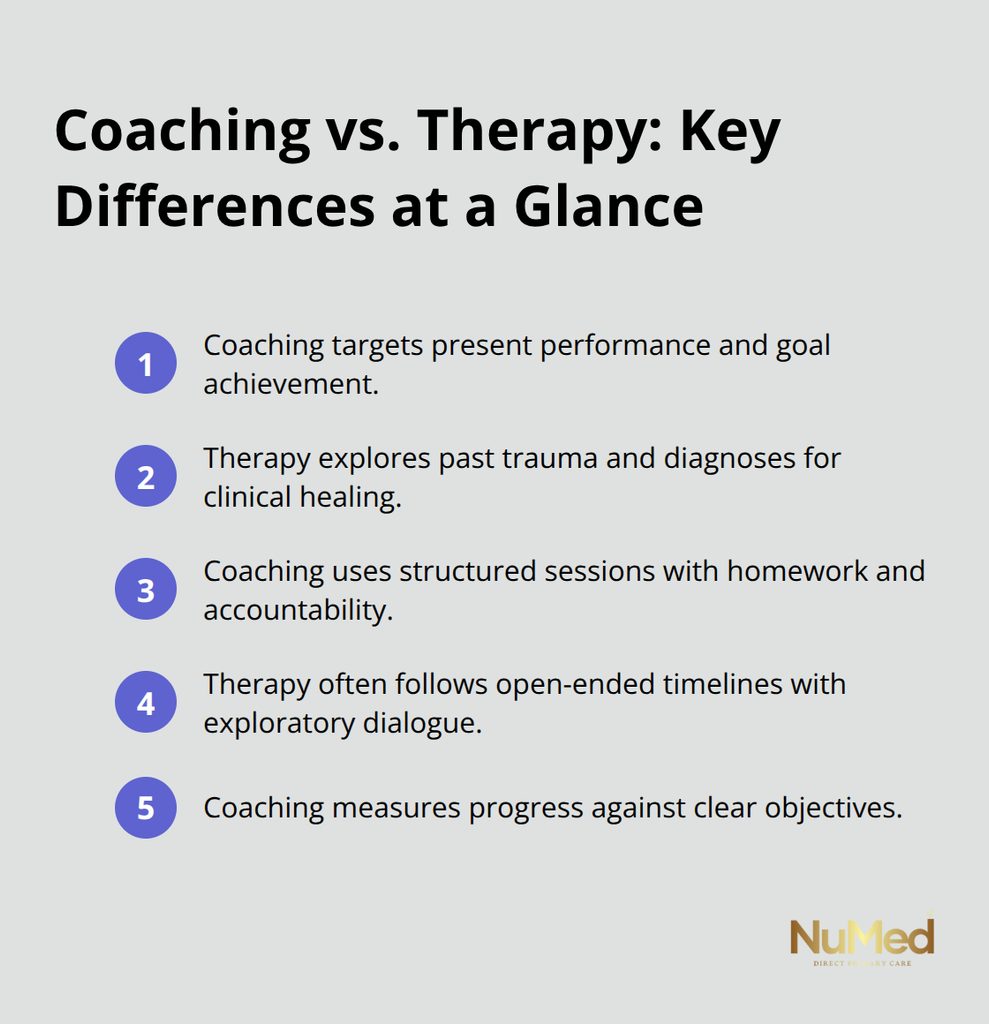
Mental health coaching and traditional therapy tackle different problems in fundamentally different ways. Therapy typically addresses past trauma, diagnosed mental health conditions, and deep-seated emotional patterns that require clinical intervention. Coaching, by contrast, works with people who function reasonably well but want to perform better, build specific skills, or move toward concrete goals. This distinction shapes everything about how the work unfolds. A therapist might spend months exploring why you developed anxiety; a coach teaches you techniques to manage anxiety today and move forward tomorrow.
Research from the International Coach Federation shows that coaching clients achieved their stated goals within six months, with many experiencing measurable improvements in productivity and well-being. This action-oriented approach works because coaching operates on a fundamental principle: you already have the capacity to change-you just need practical tools and accountability to get there.
Structured Sessions Replace Open-Ended Timelines
The structural differences between coaching and therapy create vastly different experiences. Therapy sessions often run 50 minutes weekly with open-ended timelines, sometimes lasting years. Coaching typically involves 6 to 12 structured sessions over 3 to 6 months, with clear objectives established from session one.
Each coaching session has a specific agenda: you identify what you want to accomplish, work through concrete strategies together, and leave with homework you complete before the next meeting. Therapy might explore feelings; coaching builds competencies. If you struggle with procrastination, a coach teaches you time-blocking and progress-tracking methods you implement immediately. If you want to strengthen your emotional resilience, a coach develops your capacity to recognize stress signals and deploy specific coping techniques in real situations.
Why This Model Works for Practical Change
This structured goal-focused coaching model suits people who want measurable progress without the extended commitment therapy requires. You move from identifying a challenge to applying solutions within days, not months. The accountability built into coaching sessions (where you report on completed homework) creates momentum that sustains change long after the coaching relationship ends.
The combination of clinical expertise and practical skill development matters most. You need someone to identify what’s wrong and someone to teach you how to make it better. This foundation positions you to tackle the specific mental health coaching techniques that produce real results in your daily life.
Core Mental Health Coaching Techniques You Can Use Daily
Cognitive reframing interrupts negative thought patterns
Cognitive reframing stands as the most direct way to interrupt negative thought patterns before they escalate. The technique works by identifying the automatic thought, questioning its accuracy, and replacing it with a more realistic assessment. When you catch yourself thinking “I always fail at important projects,” you pause and ask: Is that actually true, or did I succeed at three projects last year and struggle with one? You then reframe to “I’ve succeeded before, and this project presents a specific challenge I can address.” Research from cognitive behavioral therapy practitioners shows that consistent reframing produces measurable shifts in mood and decision-making.
The practical application requires you to write down the negative thought, challenge it with evidence, and document the reframe in a note app or journal you check daily. This creates a record you reference when anxiety resurfaces, reinforcing the new neural pathway rather than retreating to the old one. The act of writing forces you to slow down and examine your thoughts with precision instead of accepting them as fact.
Mindfulness and Grounding Exercises Anchor You in the Present
Mindfulness and grounding exercises anchor you in the present moment when stress or anxiety pulls your attention toward worst-case scenarios. Box breathing technique, a technique used by military personnel and first responders, involves breathing in for four counts, holding for four counts, exhaling for four counts, and pausing for four counts-repeating this cycle five times. The 5-4-3-2-1 grounding method (identifying five things you see, four you can touch, three you hear, two you smell, one you taste) interrupts panic spirals by engaging your sensory system rather than your anxious thoughts.
These techniques work because they redirect your nervous system away from threat detection and toward present-moment awareness. You activate your parasympathetic nervous system, which calms your body’s stress response. Most people notice the shift within the first few minutes of practice.
Goal-Setting and Progress Tracking Convert Wellness Into Action
Goal-Setting and progress tracking convert abstract wellness objectives into concrete weekly actions you monitor. Instead of the vague goal “improve my mental health,” you specify “I will complete three grounding exercises weekly” and track completion on a calendar. Behavioral research demonstrates that tracking visible progress increases follow-through compared to unmeasured efforts.
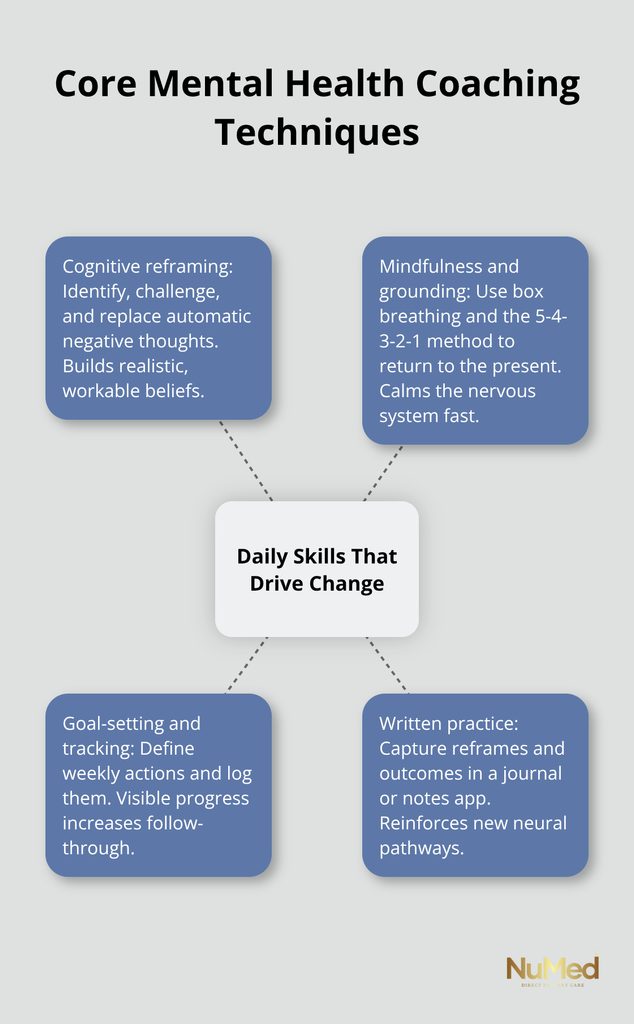
The combination of these three techniques-reframing negative thoughts, grounding in the present, and tracking measurable progress-creates a self-reinforcing system that strengthens your mental resilience without requiring constant external support. Once you establish these skills, you move toward building deeper resilience through the coaching principles that sustain long-term change.
Building Resilience Through Coaching Principles
Emotional Awareness Transforms Your Stress Response
Emotional awareness forms the foundation of resilience, and you develop it by noticing your internal states before they control your actions. Most people operate on autopilot, reacting to stress without understanding what triggered the reaction or what their body needs in that moment. The practice involves checking in with yourself three times daily, noting your emotional state on a simple scale, and identifying the physical sensations accompanying each emotion.
Mood charts can help you track emotional patterns and develop stress management skills. You might notice that anxiety tightens your chest and accelerates your breathing, while frustration creates tension in your jaw and shoulders. Once you recognize these signals, you can intervene with a grounding exercise or cognitive reframe before the emotion intensifies into a crisis. This awareness transforms you from someone who experiences emotions passively to someone who actively manages them.
Sustainable Habits Replace Motivation
Sustainable habits replace motivation as the driver of long-term mental wellness. You establish one specific habit at a time, practice it for two to three weeks until it requires minimal effort, then add another. If you commit to a five-minute grounding exercise each morning, you schedule it at the same time daily and log completion in your phone’s calendar app.
Behavioral research shows that people who tracked their progress daily and reported to an accountability partner maintained new habits at significantly higher rates after six months compared to those without accountability. The consistency matters far more than the intensity-a small daily practice produces stronger results than sporadic intense efforts.
Accountability Systems Accelerate Progress
Accountability systems ensure your habits stick and create external motivation when your internal drive fluctuates. Many people benefit from a structured accountability check-in, whether that’s a weekly conversation with a coach, a trusted friend, or a peer group focused on mental wellness. The external commitment transforms a private intention into a public promise, which activates different neural pathways than self-directed efforts alone.
The combination of emotional awareness and habitual practice produces measurable resilience gains that persist long after the coaching relationship ends. You navigate future stressors with skills rather than crisis management, and you maintain progress through systems that work even when motivation dips.
Final Thoughts
Mental health coaching tips work because they translate awareness into action. You’ve learned how coaching builds practical skills faster than traditional therapy, mastered techniques like cognitive reframing and grounding exercises, and discovered how resilience develops through consistent habits and accountability. Pick one technique from this guide, commit to practicing it for two weeks, and track what changes.
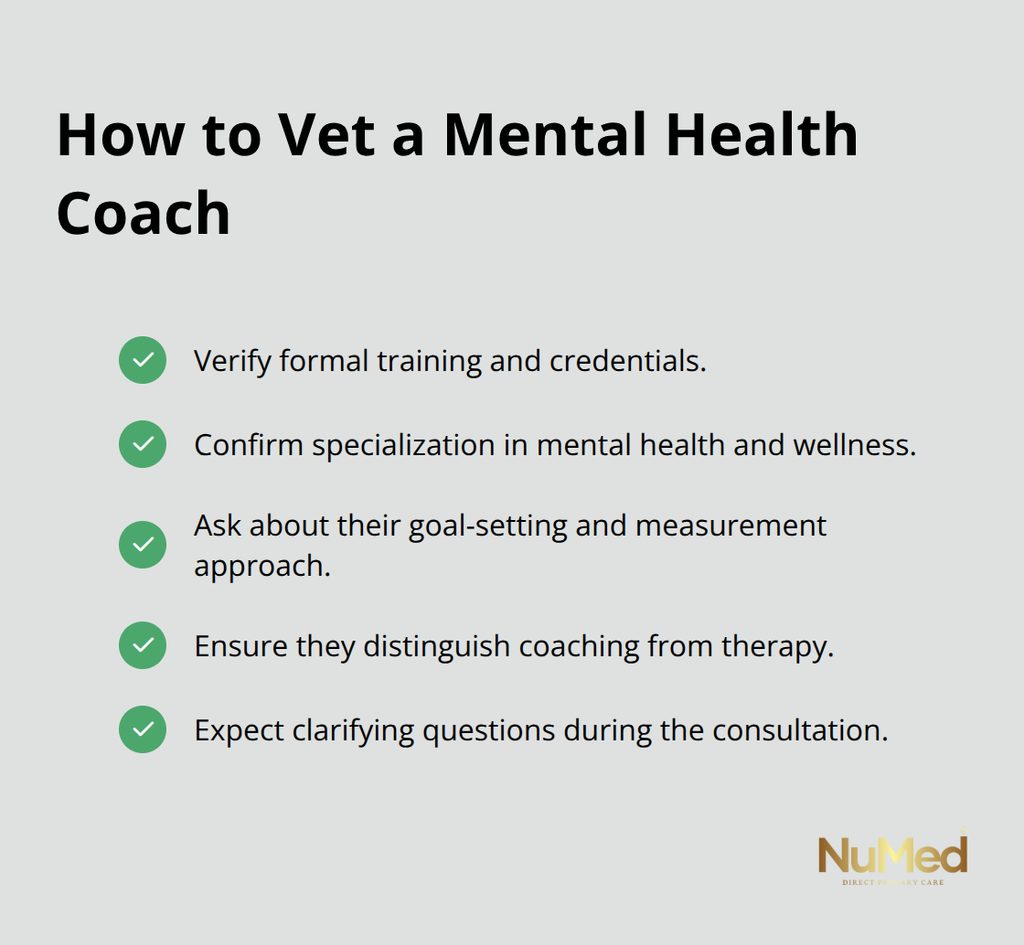
Finding a qualified mental health coach requires checking credentials and verifying they’ve completed formal training through recognized coaching organizations. Look for coaches who specialize in mental health and wellness, ask about their approach to goal-setting, and confirm they understand the difference between coaching and therapy. A good coach asks clarifying questions about your specific objectives during an initial consultation and explains how they’ll measure progress throughout your engagement.
We at NuMed DPC recognize that mental wellness connects directly to your overall health. Our direct primary care model includes health coaching alongside comprehensive medical care, addressing both your physical and emotional needs through personalized treatment. When you have a healthcare partner who understands your complete picture, you build sustainable wellness that extends far beyond any single technique or session.